Pedicle Screw Placement and Augmentation
In this spine surgery lecture, principles of pedicle screw placement and vertebral augmentation are covered.

Enrol to View This Lecture
Access to all 180 Spine Lectures with our Spine Surgery Education Programme.
Lecturer: Eyal Behrbalk, MD
Includes:
- Online Lecture Presentation
- Pre- and Post- Learning Assessments
- Additional Learning Materials (Standard Package only)
- Up to 3 CME Credits
Ref.ID: 7_15_behrbalk
DOI: 10.28962/01.3.139
What you will cover in this lecture
In this spine surgery lecture, the principles of pedicle screw placement and vertebral augmentation are covered. The spine is the most common site of metastasis. Most commonly a palliative surgery with fixation is needed. Pedicle screws are an excellent choice for posterior spinal fusion in metastatic spine disease. Knowing the wide arsenal of techniques, materials, biomechanics and pros and cons of each side will result in better pre-operation planning and post-operation results. Due to bone quality/density, augmentation with cement should be considered in any spinal fixation due to metastasis. Augmentation affects the screw/bone interface and increases the pullout strength which allows stronger fixation and stabilisation. Always hope for the best but be prepared for the worst, master all aspects and have a bailout for each scenario.
Learning Objectives
- To understand surgical anatomy of the vertebrae and pedicles in particular
- To learn basic mechanics of the pedicular screw and biomechanics of spinal fixation
- To understand principles of pedicle screw placement
- To obtain knowledge about types, indications and techniques of cement augmentation
Target Groups
Practicing Spine Surgeons
in Orthopaedic or Neurosurgical services for Continuing Education or recertification







Lecture Presentation
Pedicle Screw Placement and Augmentation
Includes:
- Online Lecture Presentation
- Pre- and Post- Learning Assessments
- Additional Learning Materials (Standard Package only)
- Up to 3 CME Credits
Enrol to View This Lecture
Access to all 180 Spine Lectures with our Spine Surgery Education Programme.
Frequently Asked Questions
Q: What is an eccElearning Lecture like?
A: Each Lecture includes the Lecture Presentation, Additional Learning Resources, Pre-Learning Quiz and Lecture Assessment.
Each Spine Surgery Lecture is viewed online in video format and lasts from 20-45 minutes. The Lectures contain relevant additional learning resources (book chapters, research papers, surgical videos, master lecture videos, case reports, review articles, etc.), which are presented in context and viewable immediately for your convenience.
Lecture 5.1 is an invited Master Lecture and does not include the Quiz and Assessment components.
Q: How much time will a Lecture take?
A: Lecture presentations typically take 20-45 minutes to run. However, candidates are required to review the compulsory and recommended additional learning resources contained within the Lecture. The time taken to view the Lecture and review the additional resources is in the range 3-4 hours per Lecture.
Q: What kind of credits do I get from the Lecture?
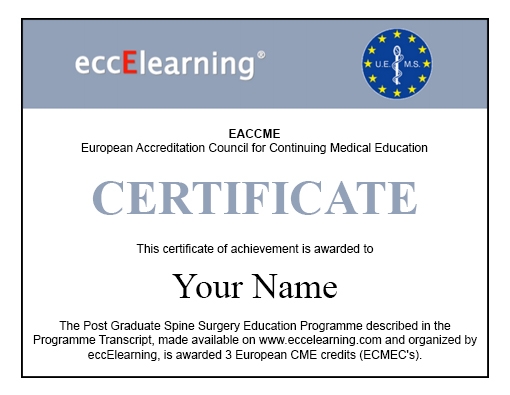
A: Each Spine Surgery Lecture can confer up to 3 Continuing Medical Education (CME) credits, certified by European Accreditation Council for Continuing Medical Education (EACCME). The CME credits are awarded to the candidate on successful completion of the online Lecture. The number awarded depend on the number of additional learning materials available in a Lecture - premium versions of the Diploma and Modules include more material for each lecture, so confer more CME Credits.
Q: What payment methods are accepted?
A: All major credit and debit cards.
Q: What are CME Credits?
A: CME stands for Continuing Medical Education. You are awarded CME Credits for undertaking an approved course of medical education. Each Lecture that you complete successfully adds to your CME Credits total. All Lectures provided by eccElearning are accredited by the European Accreditation Council for Continuing Medical Education (EACCME), of the Union Européenne des Médecins Spécialistes (UEMS). You can print out your Certificate of CME Credits after the completion of any Course or Lecture.
Q: What do I do if I fail a Lecture Assessment?
A: You are permitted to retake a Lecture Assessment up to two times. The Lecture Assessment will be made available to you again 14 days after a failed attempt. If you’ve failed the Lecture Assessment three times, please get in contact with us to discuss your options.
Q: What courses does eccElearning provide?
A: We have the Diploma in Spine Surgery with Modules individually purchasable, and Spine Surgery Specialist Certificates in Radiology and Physiotherapy.